
Blog
Factors affecting cone crusher efficiency
A high-capacity secondary crusher is only as efficient as the material flow feeding it. Analyzing a stalled 400 tph granite circuit in Ontario this April 2026 revealed a textbook architectural failure. The plant manager blamed the HPT300 for missing production targets, but the kinetic reality told a different story. The machine was starving on one side and choking on fines on the other. You cannot evaluate a cone crusher in a vacuum; its efficiency is entirely dictated by pre-screening accuracy, volumetric feed geometry, and downstream recirculating load control.
Arresting Feed Segregation and Cavity Imbalance
An unbalanced feed trajectory destroys the eccentric assembly before the mantle ever wears out.
When material drops from a primary belt conveyor into the cone’s feed hopper, gravity and momentum separate the rock. If the belt lacks a proper material distributor, large boulders cascade to one side of the chamber while fine material segregates to the opposite side. This is lethal to the internal kinematics.
Asynchronous feeding causes the 250 kW motor to fight a localized kinetic load. The side receiving 230mm boulders experiences massive pressure, pushing the main shaft laterally and grinding the eccentric copper bush. Simultaneously, the side filled with fines fails to initiate laminated crushing. To stabilize production, architects must deploy dynamic feed distributors or surge bins directly above the machine, ensuring a perfectly homogenous 360-degree material drop into the cavity.
HPT300 Kinetic Load & Efficiency Thresholds
- Volumetric Target: 110-440 tph (Requires continuous choke feed)
- Pre-Screening Mandate: < 10% fines entering the crushing cavity
- Kinetic Power Draw: 250 kW (Must remain symmetrical across the phase)
- Recirculating Load Limit: 15-25% (Exceeding 35% triggers feed throat choking)
- Eccentric Velocity: 800 rpm for optimal inter-particle collision
Technical Index: LH-FACTORS AFFECTING CONE CRUSHER EFFICIENCY-APR/2026-Ref-#82914
The Physics of Choke Feeding vs. Cavity Starvation
Operating a cone crusher at 50% capacity is industrial sabotage. The factors affecting cone crusher efficiency are heavily tied to the “stone-on-stone” laminated crushing principle. If the chamber is only partially full, 220 MPa rock simply bounces against the manganese steel. This single-particle compression generates flat, elongated shards and accelerates hardware amortization.
Field Note: You can hear the efficiency drop. A properly choke-fed HPT300 emits a deep, rhythmic hum as the rocks crush each other in a dense bed. A starved cavity sounds like a metallic clatter, indicating raw metal-on-rock impact.
Continuous choke feeding is mandatory. By keeping the feed hopper buried under a constant head of material, the 800 rpm eccentric speed translates its energy directly into the rock mass. The particles are forced to collide and fracture along their natural mineral boundaries, maximizing the 0-10mm cubical yield and minimizing direct abrasive wear on the mantle.
Pre-Screening Deficits and “Dead Rock” Processing
A secondary cone crusher is designed to break rock, not to pass dirt. If the vibrating screen positioned before the cone is undersized or operating with blinded mesh, fine material that is already at the target size will bypass the screen and enter the crushing chamber.
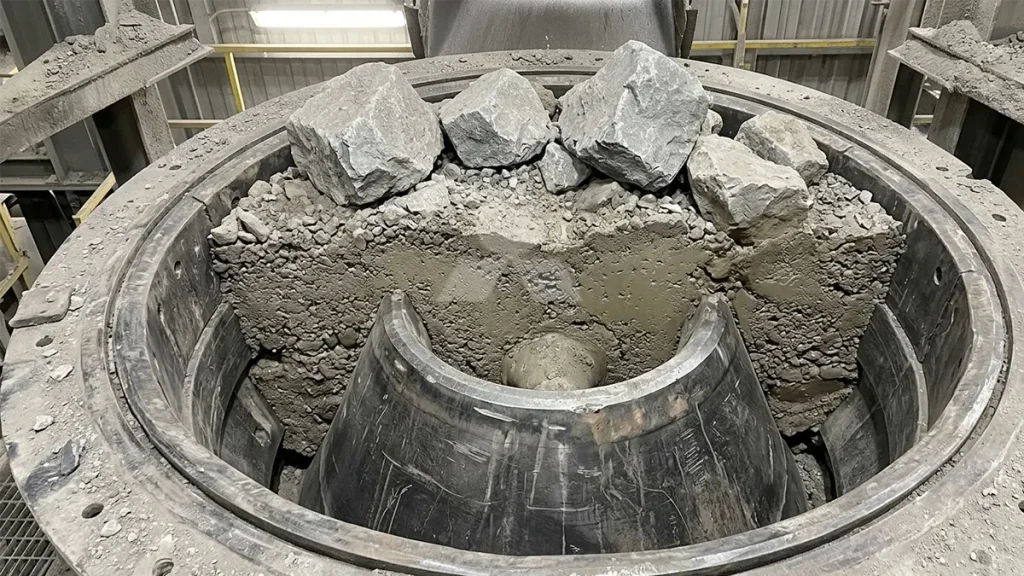
This is classified as “dead rock.” A 15% drop in pre-screening fine removal forces the HPT300 to process material that needs no further reduction. This non-crushable volume acts like a dense sponge, absorbing the hydraulic clamping force and dropping the actual shaping efficiency by up to 22%. It immediately spikes the 250 kW motor amp draw while choking the volumetric throughput of fresh, crushable boulders.
Synchronized Circuit Matrix for Flow Optimization
To isolate the factors affecting cone crusher efficiency, you must map the upstream and downstream bottlenecks.
| Process Stage | Recommended Equipment | Capacity (tph) | Power (kW) | Architectural Function |
|---|---|---|---|---|
| Primary Feed Control | F5X1260H Feeder | 600-800 | 22 | Surge mitigation & steady volumetric flow |
| Pre-Screening Definer | S5X1860-2 Screen | 75-600 | 15 | Scalping fines to prevent “dead rock” processing |
| Secondary Crushing | HPT300 Cone Crusher | 110-440 | 250 | Laminated choke-fed inter-particle shaping |
| Closed-Circuit Grading | 3SKX1860 Screen | 70-400 | 22 | Controlling the recirculating load (< 25%) |
The matrix above eliminates guesswork. If the 3SKX1860 screen fails to process the output fast enough, the recirculating load will flood the return belt. You will smell the burning rubber before the cone crusher’s feed throat completely backs up.
Enforce Material Flow Geometry to Arrest Downtime
You cannot buy efficiency by simply installing a larger machine; you must architect the flow. The factors affecting cone crusher efficiency are violently exposed when pre-screening fails and feed segregation destroys the cavity balance. Next month, if you continue to allow asynchronous feeding and ignore a blinding downstream screen, your recirculating load will choke the HPT300, shattering the eccentric copper bush and crippling your capital payback velocity. Stabilize your upstream belts and enforce choke feeding immediately.
Arrest Feed Segregation and Synchronize Circuit Flow
“What is the exact percentage of your current recirculating load? Send us your primary belt trajectory data, and let’s engineer a homogenous feed distributor.” — From the Desk of your The Solution Architect
Calibrate Circuit Architecture For Fiscal Efficiency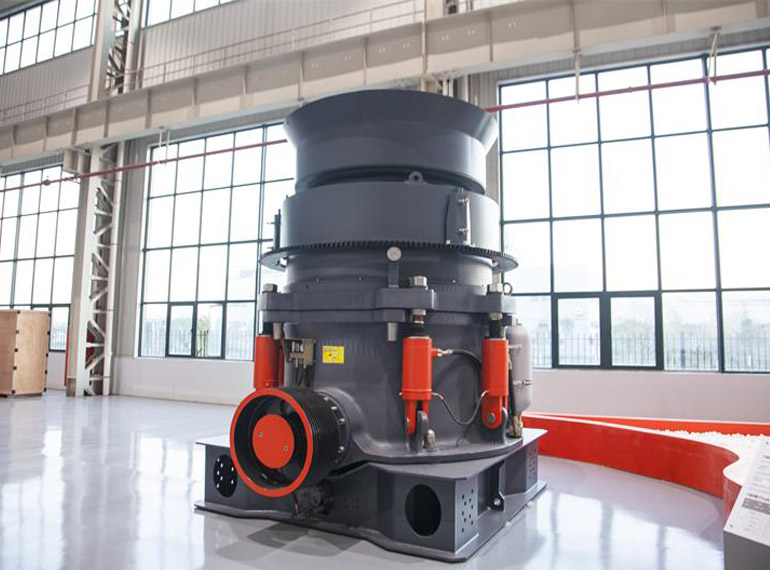


Get Solution & Quotation