
Blog
Basalt Crushing Machine For Railway
Auditor’s Baseline: Producing 20-60mm railway ballast from 230 MPa volcanic rock requires a brutal zero-tolerance mass balance. You must ban impact crushers to stop silica friction hemorrhaging, deploy heavy C6X jaw frames to prevent internal rock micro-fracturing, and mandate VSI ‘rock-on-rock’ shaping to cure those splinters and pass strict Los Angeles Abrasion audits.
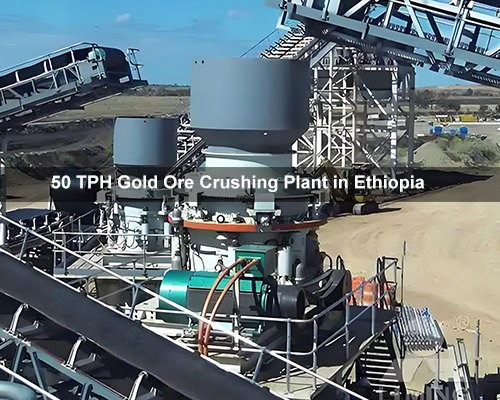
Back in the July 2025 ballast production audit for the high-speed rail extension deep in the Ethiopian Highlands, the principal contractor was hemorrhaging capital. They were failing the government’s Los Angeles Abrasion test. The legacy primary jaw was over-compressing the 230 MPa basalt, inducing deep internal micro-cracks before the rock even reached the secondary circuit. We ripped out the legacy frame and deployed the C6X125 Jaw Crusher operating at 160 kW. By strictly calibrating the Closed Side Setting to 130mm, the heavy cast-steel frame absorbed the massive kinetic shock. It fractured the 750mm boulders cleanly, stabilizing the primary feed without compromising the internal structural integrity of the stone.
Silica Friction and the Mantle Survival Mandate
Feeding volcanic rock into a high-speed impactor is an intentional act of financial suicide.
The Ethiopian basalt deposit possessed a brutal 56% silica content. To cut their initial equipment price, a local subcontractor attempted to run a European secondary impactor. The mechanical physics were unforgiving. The extreme abrasive friction generated by the silica literally melted their high-chrome blow bars into useless scrap metal in 22 hours. The expenditure per shift skyrocketed, paralyzing the site.
We audited the circuit and deployed an HST315 single-cylinder cone. You fight 230 MPa hardness with sustained compression, not kinetic impact. The inter-particle compression and hydrostatic pressure buffering of the HST absorbed the extreme abrasive resistance. By allowing the cone to dynamically clear uncrushable materials without stalling the 315 kW motor, we extended the manganese mantle survival rate by over 300%. This hardware pivot stabilized the daily running costs and restored the capital payback velocity.
Ballast Physics: Curing Micro-Cracks and Flakiness
Government railway auditors instantly reject ballast with a flakiness index above 8%. Elongated, splintered stones fail to interlock. Under the violent dynamic load of a 15,000-ton freight train, these flat stones snap, causing catastrophic track subsidence. Because cone crushers inherently compress rock into slabs, the HST output sat at a completely un-sellable 12% flakiness.
We routed the 20-60mm fraction directly into a VSI6X1150 Sand Maker. We strictly bypassed the metallic anvils, configuring the machine for ‘rock-on-rock’ kinematics. Operating at 250 kW under a choked-feed condition, the rotor accelerated the basalt into a dense material bed. The violent particle collisions abraded the weak edges and structurally “cured” the internal micro-cracks induced by earlier compression. The flakiness index plummeted to a pristine 4.2%, effortlessly passing the structural compliance audit.
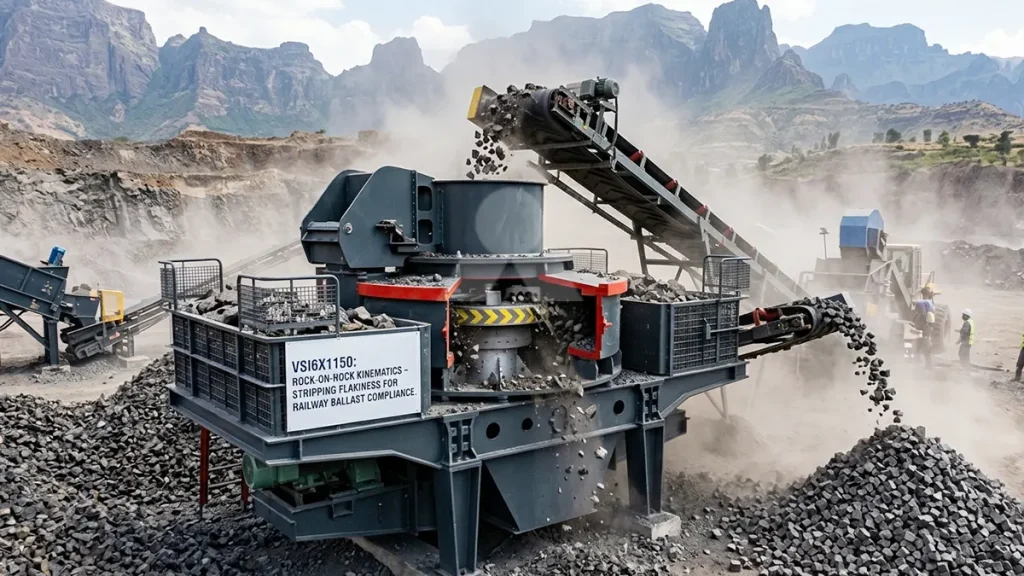
To sustain commercial-grade railway ballast production, the physical capacities of the compression, shaping, and grading stages must be flawlessly synchronized. The matrix below dictates the baseline engineering.
If you fail to extract the fines at the grading stage, the resulting mud will pool water under the tracks, causing immediate foundation rot.
| Process Stage | Recommended Model | Capacity (tons per hour) | Power (kilowatts) | Kinematic Function |
|---|---|---|---|---|
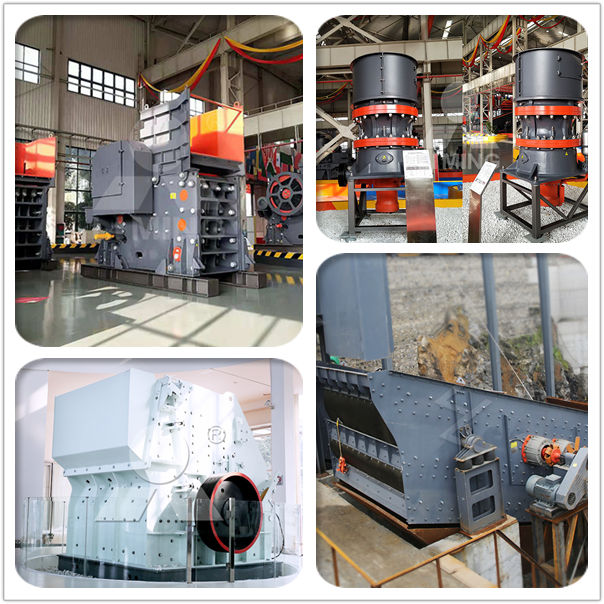
| Primary Shock Absorption | C6X125 Jaw | 230-760 | 160 | Heavy Compression (Anti-Micro-Fracture) |
| Secondary Reduction | HST315 Cone | 170-1050 | 315 | Hydrostatic Compression |
| Tertiary Ballast Shaping | VSI6X1150 Sand Maker | 344-663 | 250 | Rock-on-Rock Attrition |
| High-Precision Grading | S5X2460-3 Screen | 100-800 | 30 | High-Amplitude Stratification |
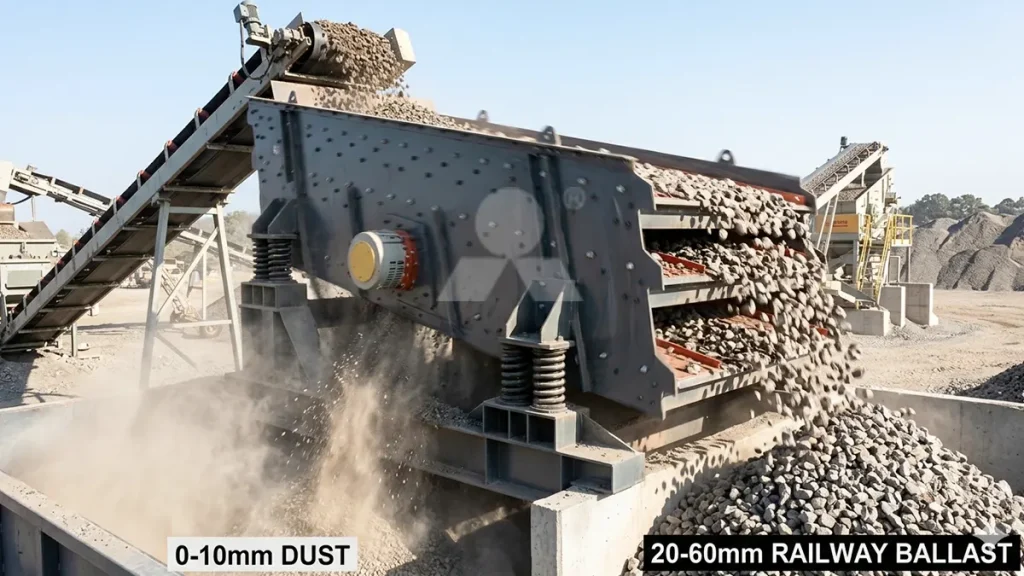
Railway ballast mandates near-zero fines to ensure proper track drainage. The jagged basalt was pegging the mesh on the standard screens, allowing 3% fines to bypass into the final stockpile. We integrated the S5X2460-3 vibrating screen, increasing the inclination angle to exactly 18 degrees. The high-amplitude stroke forcefully ejected the 0-10mm dust, locking the final fines content below 0.4% and passing the strict environmental and structural railway compliance audit.
Ballast Degradation & Manganese Fatigue Autopsy
- Why does 230 MPa basalt melt secondary impactor blow bars?
- Look at the silica friction coefficient. When a high-chrome blow bar strikes 56% silica rock at 600 RPM, it generates microscopic plasma arcs. The heat destroys the metallurgical temper of the steel, turning hardened metal into soft clay that simply grinds away in hours.
- How did operators survive basalt kinetic shock ten years ago?
- Ten years ago, operators poured 300 cubic meters of extra concrete to anchor standard jaws, and the frames still cracked. The C6X design shifted the absorption from the foundation to the heavy cast-steel frame itself, isolating the kinetic recoil and preserving the internal integrity of the stone.
- What happens if you bypass VSI shaping on railway ballast?
- If you skip the VSI, you submit 12% flakiness to the railway auditor. When a 15,000-ton train rolls over flat, elongated basalt, the stones snap. This removes the volume from the track bed, causing the rails to sink, warp, and ultimately derail the train. VSI shaping cures this fatal structural flaw.
- Why does flakiness persist if the VSI feed rate drops too low?
- When you starve a VSI of material, the internal ‘rock-on-rock’ material bed collapses. The splinters bypass the particle collision zone and exit the machine untouched. You must maintain a choked-feed condition to sustain the abrasive density required to grind off the friable edges.
Arresting Track Subsidence and Capital Hemorrhage
The mechanical reality of producing railway ballast from basalt is a zero-tolerance war against silica abrasion and internal micro-fractures. If you attempt to process 230 MPa volcanic rock using secondary impact crushers, the silica friction will literally vaporize your blow bars, driving your expenditure per shift into immediate bankruptcy. Bypassing tertiary VSI rock-on-rock shaping ensures your aggregates retain a 12% flakiness index, guaranteeing rejection by every government railway auditor. Synchronizing your heavy C6X primary compression with rigorous HST hydrostatic cone loops and strict S5X fines removal is the only non-negotiable operational boundary. If you do not lock your flakiness below 5% and your fines below 0.4%, your entire production line will face total contract cancellation before the end of the month.
Stop Guessing on Flakiness Limits and Silica Abrasion
“If you feed basalt into an impactor, you are intentionally destroying your capital. Synchronize your cone compression now.” — From the Desk of your Risk Auditor
Audit Ballast Circuit Payback Velocity

Get Solution & Quotation